Horsies is currently the most complete pure-Python library that delivers all of the following under one roof:
- First-class DAG workflows (including subworkflows, joins, success policies, and pause/resume)
- Type-safe task and workflow contracts by design
- A transactional claim / finalize / fencing model as the task queue itself
- Strong recovery semantics, immutable attempt history, and operational visibility
- Optimised statements with 0–2 ms server latency
-
A static validation gate (
horsies check) that turns entire classes of foot-guns into CI or boot-time failures — an invalid schedule, for instance, will not boot the scheduler service
It is not "Celery with a nicer API" and it is not a lightweight Postgres job table wrapper.
It is a complete re-imagining of what a background execution system should look like when correctness, composability, and inspectability matter more than maximum fire-and-forget throughput.
Design philosophy
Its design eliminates the need of hand-rolling a weak state machine around light task queues.
You just need to use the core primitives of Horsies, and you will be able to compose any conditional orchestration flow that your business depends on.
Three common misreads should be avoided from the start:
- Postgres is the enabling substrate, not a cost-saving substitute for Redis.
- Pre-1.0 is an API-contract statement, not an engine-maturity statement. Breaking API changes may land in minor releases, documented in the changelog.
- Horsies is not a plain message queue. Absolute highest message streaming belongs to Redis/Kafka-class systems.
Core primitives: tasks
Every task must return a typed
TaskResult[T, TaskError]:
@app.task("add_numbers")
def add_numbers(*, a: int, b: int) -> TaskResult[int, TaskError]:
    return TaskResult(ok=a + b)
Errors are values, no raises.
The library provides structured error-code families
(Operational, Contract,
Retrieval, Outcome) plus
user-defined Domain codes.
Exception mappers (global or per-task) and
default_unhandled_error_code let teams keep
their own vocabulary while still capturing unhandled
crashes as structured data instead of silent log lines.
In other libraries, you would need a log monitoring service to catch those raises, whereas silent raises are not possible by design in Horsies.
Retries are explicit via RetryPolicy
(fixed or exponential, with
jitter). Timeouts (timeout_ms) SIGKILL the
child process; the sibling tasks on that worker recover
through the normal crash-recovery path.
Deadlines (good_until) are first-class and
produce a distinct EXPIRED outcome.
Pydantic / dataclass support and serialization
You do not have to manually model-validate on the receiving side the way many other task queues force you to.
You can pass Pydantic models and dataclasses like regular Python arguments and return values. The library handles encoding and decoding against the declared types.
from horsies import Horsies, TaskResult, TaskError
from pydantic import BaseModel

app = Horsies(config)

class Order(BaseModel):
    id: int
    items: list[str]

@app.task("process_order")
def process_order(*, order: Order) -> TaskResult[Order, TaskError]:
    return TaskResult(ok=order)
Read more about serialisation in the docs.
Workflows
Workflows are static DAGs of TaskNodes and
SubWorkflowNodes.
Two construction styles are supported:
-
Functional / dynamic (
app.workflow()+.node()) -
Class-based (
WorkflowDefinitionwith attribute nodes andMeta)
Nodes support:
-
waits_for,args_from/from_node(typed result injection) -
Join modes:
all,any,quorum allow_failed_deps-
Success policies with
required/optionalcases -
OnError.FAILorOnError.PAUSE(human-in-the-loop) - Subworkflows that become first-class child runs with their own graphs
The engine treats workflow state transitions with the same transactional approach as task claims.
A simple example:
class DeliveryWorkflow(WorkflowDefinition[str]):
    name = "delivery"
    definition_key = "myapp.delivery.v1"

    pickup = TaskNode(fn=pickup_package)
    deliver_door = TaskNode(fn=deliver_to_door, waits_for=[pickup])
    deliver_neighbor = TaskNode(fn=deliver_to_neighbor, waits_for=[pickup])
    deliver_locker = TaskNode(fn=deliver_to_locker, waits_for=[pickup])

    class Meta:
        output = deliver_door
        # Workflow succeeds if ANY delivery method works
        success_policy = SuccessPolicy(cases=[
            SuccessCase(required=[deliver_door]),
            SuccessCase(required=[deliver_neighbor]),
            SuccessCase(required=[deliver_locker]),
        ])
Static validation: horsies check
This is one of the library's most distinctive features.
horsies check myapp.config:app [--live]It runs a multi-phase validation:
- Configuration (Pydantic)
- Task module imports
- Full DAG validation (cycles, missing deps, type mismatches, serializability, definition keys, and the rest of the HRS-001–HRS-031 family)
-
Execution of
@app.workflow_builderfunctions under send suppression - Detection of undecorated builders
- Policy and schedule safety
- Optional live broker connectivity
Workers and schedulers also run the non-live version
at startup. A malformed schedule, cyclic graph,
missing definition_key, or
unserializable kwarg simply prevents the process from
booting. This is a level of static safety that most
Python task/workflow systems still lack.
Operational model
- Queues with priority and per-queue concurrency limits
- Cluster-wide caps and soft/hard prefetch controls
- Child-process recycling by task count or RSS memory
- Heartbeats, stale-task reaping, orphaned workflow task termination
-
Typed monitoring query API + optional web dashboard
(
horsies[web]) and TUI -
Schedules:
Interval,Hourly,Daily,Weekly,Monthly, and a fully typedCronSchedulethat can express constructs classic cron strings struggle with
The dashboard, mid-run
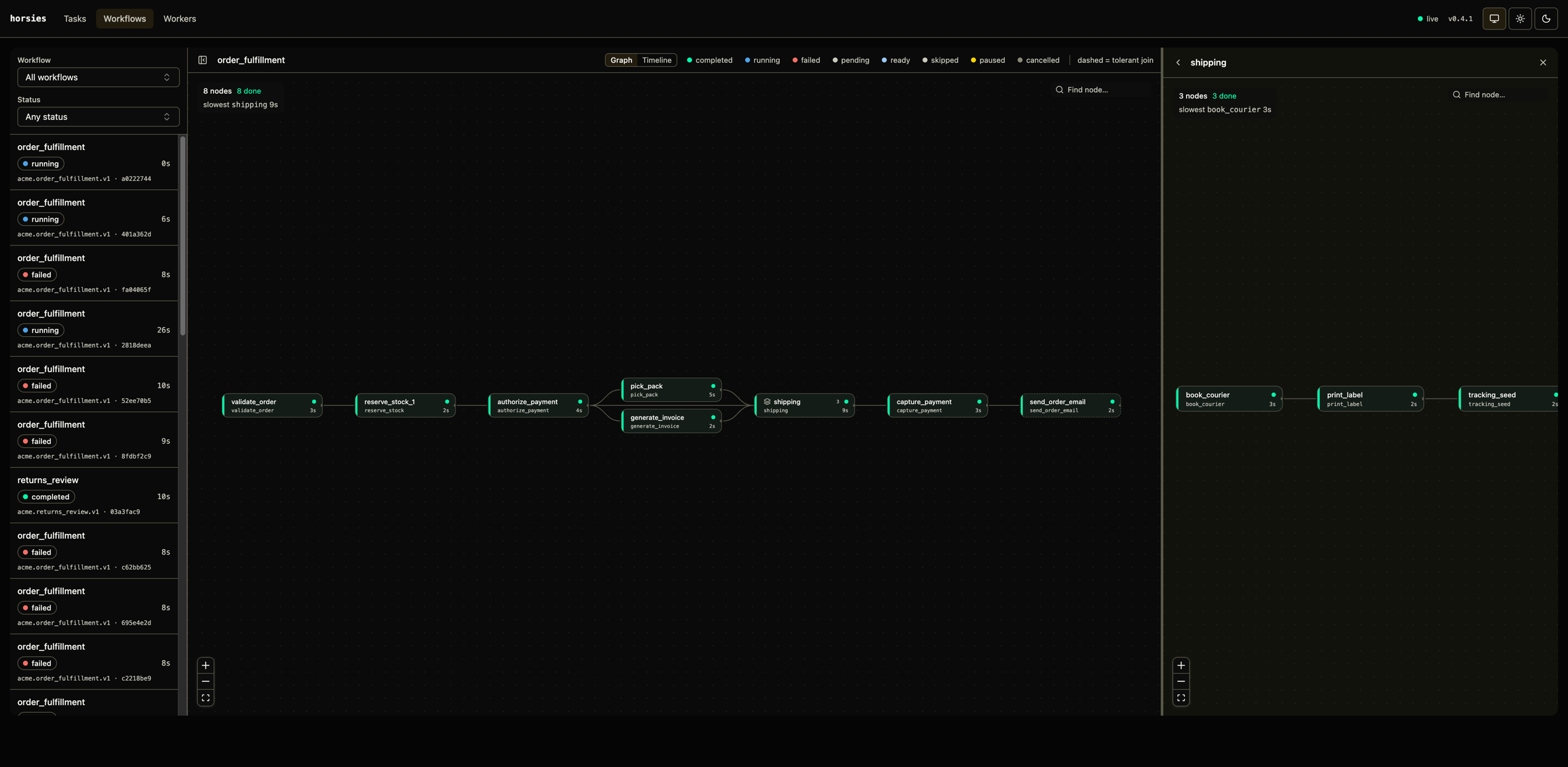
order_fulfillment run from the
showcase app. Each node carries its own status and
duration, the slowest node is called out at the graph
level, and the shipping node opens as a
subworkflow with its own graph rather than as an
opaque step. Dashed borders mark tolerant joins.
Open full size →
All history lives in ordinary Postgres tables. You can inspect it with SQL, back it up with your normal tools, and reason about it without a proprietary event store.
Performance (reference shape)
On separate machines in the same region against an entry-tier managed Postgres:
- ~2.5 M statements / 24 h across the top-20 statements
- No top-20 statement exceeds 2 ms p99
- Claim function: p50 1 ms / p99 2 ms at ~150 k claims/day
These are server-side per-statement latencies.
The numbers are not the ceiling, just reference. You can achieve higher throughput with the same or better performance depending on your Postgres service.
Showcase: Acme Clothing
You can see it live at horsies-showcase.suleymanozkeskin.com.
The repository includes a full demonstration application: a fictional fast-fashion retailer whose orders, payments, stock, and shipments are real rows in a real Postgres database. External systems are simulated.
It exercises 35 tasks, multiple workflows (including dynamic per-order DAGs and subworkflows), 4 priority queues, 31 schedules, intentional process kills, human-in-the-loop pauses, success policies, quorum joins, timeouts that restart process pools, and full recovery.
The showcase exists to make the library's claims observable rather than theoretical.
Landscape comparison
| System | Model | Strengths | Trade-offs |
|---|---|---|---|
| Celery / Dramatiq | Classic broker (Redis/AMQP) | Ecosystem, maturity, throughput | Weaker ownership model, limited native workflows, more foot-guns |
| Procrastinate / Chancy / PGQueuer | Postgres job queue | Simple, same-DB | Limited or plugin-level workflow support |
| Temporal | Durable execution platform | Battle-tested, multi-language, history | Heavier operational surface, different programming model |
| Horsies | Postgres-native library | Transactional claims + first-class typed DAGs + static validation | Pre-1.0, smaller community, dedicated broker recommended |
When to choose Horsies
Good fit when
- You are building a Python + Postgres product with real multi-step, conditional, failure-aware business processes
- You want orchestration to be expressed as code rather than hand-rolled state machines
- Type safety, early validation, and inspectable history matter
- You are willing to run a dedicated Postgres instance for the broker
Less ideal when
- You only need simple fire-and-forget or delayed jobs
- You require extreme throughput or streaming fan-out
- You need multi-language workers or the absolute most battle-tested durable-execution platform today (Temporal remains stronger there)
- Your team cannot accept a still-evolving (pre-1.0) public API
Current status
Horsies is pre-1.0. The API may still change in minor releases. The engine itself has received substantial investment in failure-path testing, recovery semantics, and cross-validation. Real production use exists, including an HR platform serving hundreds of companies. Public visibility is still low; engineering quality and production evidence are currently stronger signals than GitHub stars.
EXPLAIN ANALYZE plan pinning. Claim/finalize
semantics are cross-validated against an independent Rust
reimplementation of the same model.
Closing
Most Python applications that start with a simple task queue eventually grow non-trivial orchestration. At that point teams face a choice: keep bolting state machines onto a visibility-timeout broker, adopt a heavier durable-execution platform, or use a library that treats transactional ownership and typed workflows as core.
Horsies is an opinionated answer to that third path. It is not the right tool for every workload, but for pure-Python, Postgres-centric systems whose background work is actually business logic, it currently offers one of the most coherent and carefully engineered combinations of queue + workflow + static safety available.
The best way to evaluate it is still the same as any
serious infrastructure library: read the failure
semantics, run the showcase, put horsies check
in CI, and measure it against the orchestration you
already know you will need.